- Data Calling
- Posts
- Influence on Federal Policy
Influence on Federal Policy

Stefan Hankin
April 07, 2026
Influence is quickly becoming a defining issue in American politics, and it’s showing up in how people think about power and, more specifically, their relationship to said power. More and more, the conversation isn’t just about policies or parties, but about who is actually shaping or manipulating the decisions behind the scenes. From corporate campaign contributions and wealthy donors to lobbying from corporations and issue-based groups, Americans are increasingly focused on the different channels of influence and who benefits from them. The long-held perspective is that large corporations are often seen as holding the most sway, while small businesses and the average American struggle to compete for a meaningful voice.
What makes this especially important is what it signals about how people view the whole system itself. When influence is perceived to be concentrated among a narrow band of powerful groups, it raises real questions about whose voices are actually being heard.
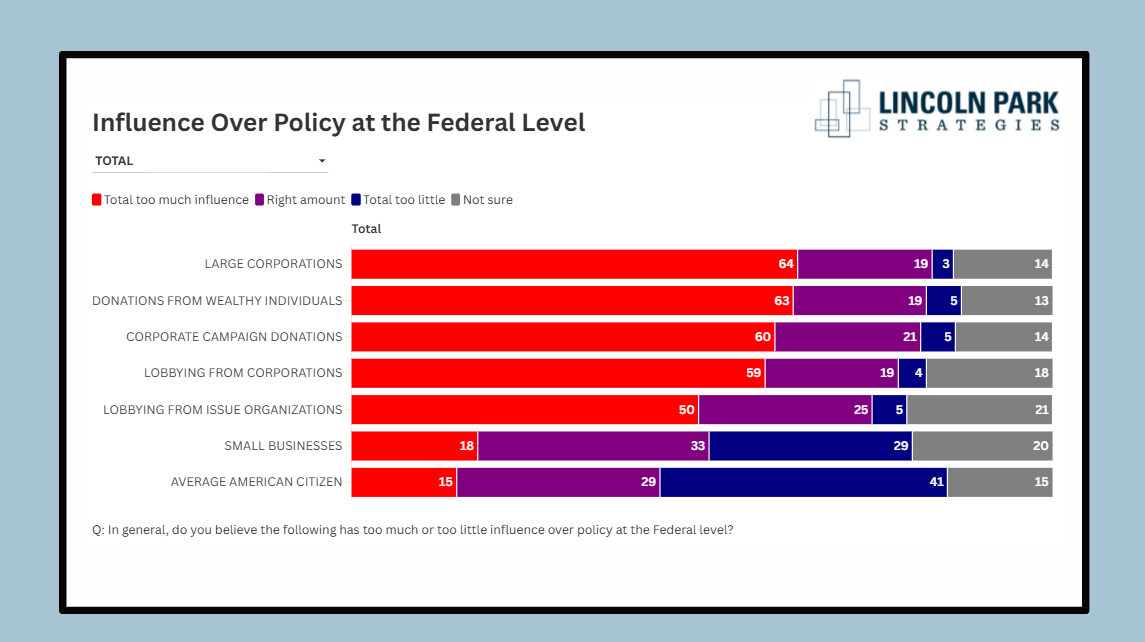
Overall, the data points to a clear and consistent narrative. Americans overwhelmingly believe that influence in politics is concentrated among large corporations and the wealthiest individuals. Nearly two-thirds (64%) of Americans feel that large corporations have too much influence, while just 19% feel it is about right and 3% feel it is too little. Donations from wealthy individuals are seen in a similar light, with 63% feeling these donations have too much influence, while corporate campaign donations (60%) and lobbying from corporations are slightly lower but in the same overall category of a majority of Americans believing they have too much influence. Lobbying from issue-based organizations lands in the middle, with opinions spread out across “too much,” “about right,” and “not sure," showing less agreement on how much influence they actually have.
In contrast, perceptions of underrepresentation are as pronounced on the other end of the spectrum. A large group of Americans (29%) believe small businesses have too little influence and, even more notably, four in ten (41%) feel the average American citizen lacks sufficient influence. The takeaway is pretty simple, people think big institutions and money have way too much power, while regular people are getting pushed to the sidelines. That gap raises some bigger questions about who’s actually being represented, and it becomes even clearer once you start breaking the data down by different groups.
Demographics
One of the more noticeable gaps shows up in levels of certainty. Women consistently report higher “not sure” responses across several categories, especially when it comes to lobbying from issue organizations and small businesses. This doesn’t necessarily indicate disagreement, but rather a greater level of ambiguity or caution in evaluating certain types of influence. Men, on the other hand, are more likely to take a firm stance, particularly in labeling corporate-related actors as overly influential.
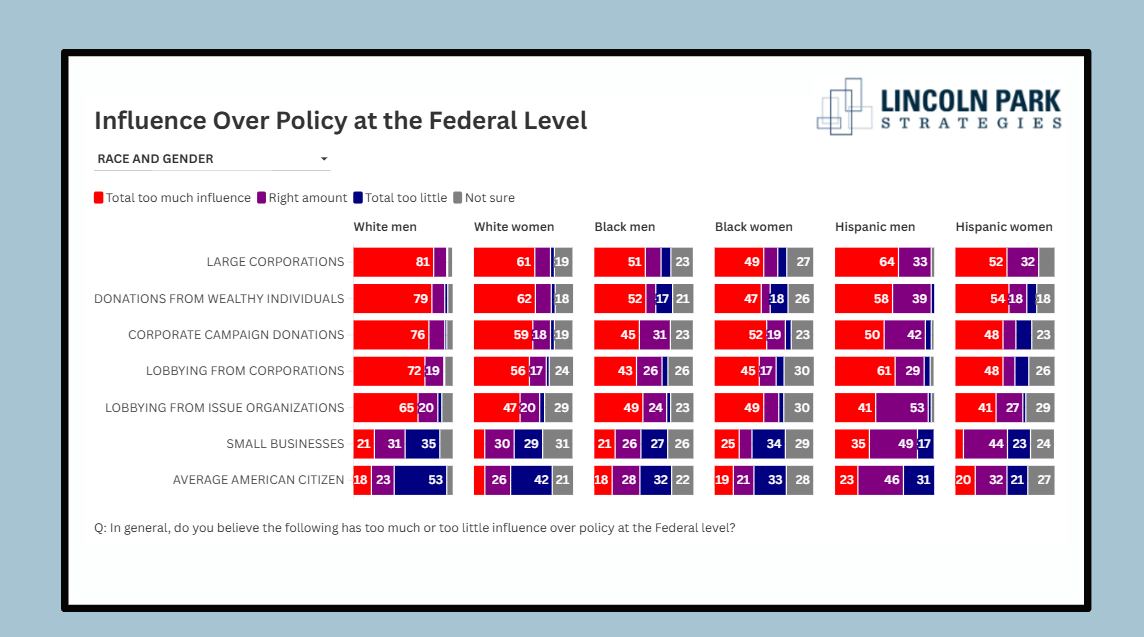
Breaking the data down further by both race and gender adds another layer to the story, showing that while the overall perception of imbalance holds, the intensity and certainty of those views vary quite a bit.
Among White respondents, especially White men, the belief that corporate and wealthy actors have too much influence is especially strong and decisive. Majorities of White men say large corporations (54%), donations from wealthy people (55%), and corporate campaign influence (56%) have “far too much” power. White women share this concern, but their responses are more spread out, with noticeably higher levels of uncertainty, often close to one in five selecting “not sure.” This mirrors the earlier gender pattern, where women are slightly less likely to take absolute positions.
Black respondents show a somewhat more mixed and less concentrated view. While both Black men and women still recognize that corporations and wealthy donors hold significant influence, fewer say “far too much” compared to white respondents, and more responses fall into “about the right amount” or “not sure.” This suggests a less unified perception of just how excessive that influence is, even if the overall direction remains the same.
Hispanic respondents stand out in a different way. Both Hispanic men and women are far more likely to say many of these groups have “about the right amount” of influence, particularly when it comes to small businesses and issue-based organizations. For example, nearly half of Hispanic men (49%) say small businesses have the right amount of influence, and a majority (53%) say the same for issue organization lobbying. This makes them the least likely group to view influence as overwhelmingly skewed, at least relative to others.
Education and Income
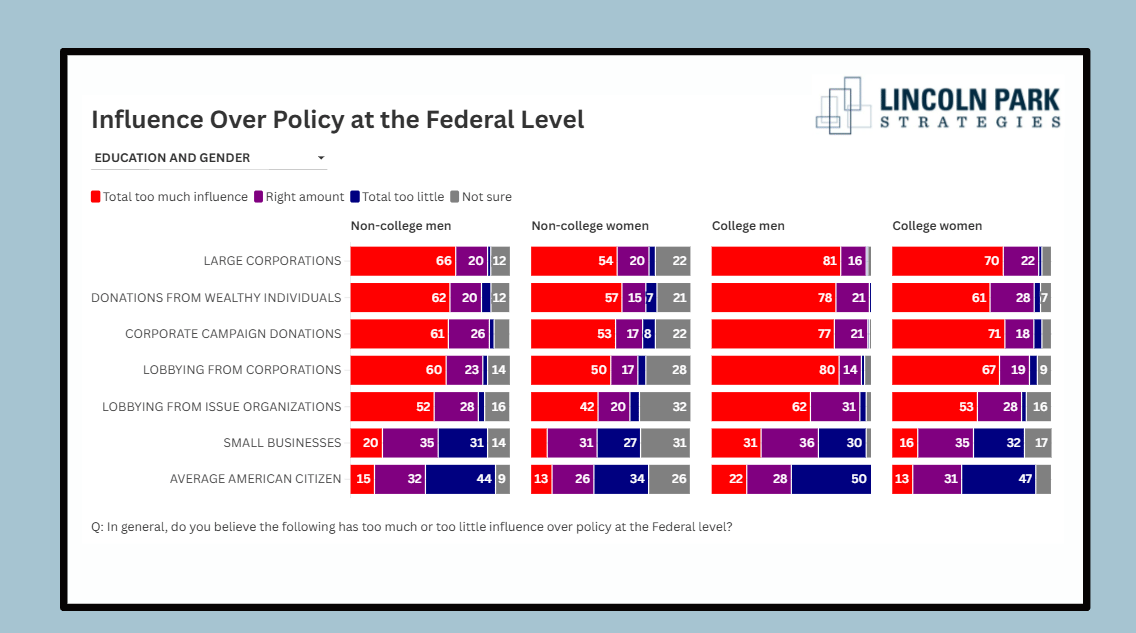
Among both college graduates and non-college graduates, there is a shared belief that large corporations, wealthy donors, and corporate lobbying hold too much influence. However, this perception becomes more pronounced as education levels increase, particularly among men. Men with a college degree show some of the strongest responses, with high percentages indicating that large corporations, corporate campaign influence, and donations from wealthy individuals have “far too much” power. However, this sentiment might not mean that they are less supportive of existing power structures, but may actually be more critical of how influence is distributed at the top.
Women with and without a degree generally reflect similar concerns, but with more variation in responses. In multiple categories, women, especially those in lower income brackets, show higher levels of “not sure,” particularly when evaluating influence from small businesses and issue-based organizations. This pattern reinforces the earlier trend that women are somewhat more cautious in assigning levels of influence, even when they broadly agree with the overall direction.
At the lower end of the income spectrum (under $40k), both men and women still recognize the outsized role of wealthy actors, but their responses are more mixed. There is a slightly higher tendency to select “about the right amount” or “not sure,” indicating less consensus or possibly less engagement with these specific channels of influence. Still, even within this group, corporations and wealthy donors are more likely to be viewed as having too much influence than too little.
Among middle-income respondents ($40k–$80k), perceptions begin to sharpen. Both men and women in this range increasingly identify corporate actors as overly influential, though men again are more likely to express this in stronger terms. At the same time, this group continues to reflect a clear belief that influence is not evenly distributed.
Individuals
Despite these differences, there is still a consistent throughline across nearly every group: the average American citizen is widely seen as underpowered. White men (53%), White women (42%), Black women (33%), and Hispanic men (31%) all report high levels of “far too little” influence for everyday people. Even in groups where opinions on corporations are more mixed, there is still clear agreement that ordinary citizens are not holding enough sway.
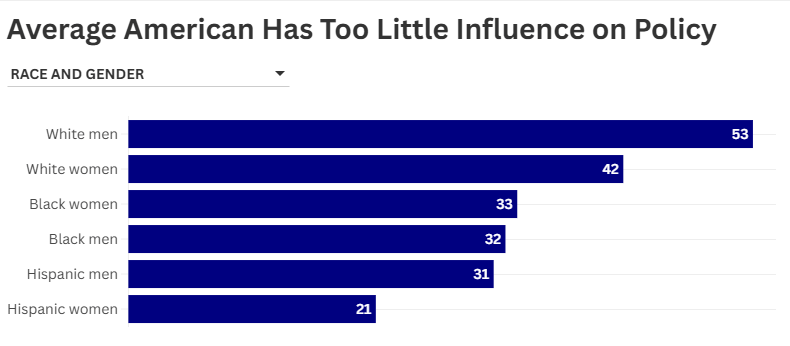
Overall, this breakdown reinforces the main narrative but adds important nuance. While most groups agree that influence tends to favor powerful institutions, White respondents, particularly men, express this most strongly; Hispanic respondents are more likely to see balance in certain areas, and Black respondents fall somewhere in between. Across all of them, though, the same core concern remains: power doesn’t feel evenly distributed, and the average person is still on the losing end of that imbalance.
Looking at the data through the lens of income and gender adds another important dimension to how Americans perceive political influence. While the broader narrative of imbalance remains consistent, the degree to which people feel strongly about that imbalance shifts depending on both income level and gender.
Across most cohorts, one pattern remains especially consistent: the average American citizen is widely seen as having too little influence. In many cases, this category receives some of the highest “far too little” responses in the dataset, reinforcing the idea that feelings of political underrepresentation are not limited to any one economic group.
Conclusion
Overall, the income and gender breakdown strengthens the central takeaway of the data while adding nuance. Perceptions of imbalance are widespread, but higher-income individuals, particularly men, tend to express these views more strongly, while women and lower-income respondents show more variability and uncertainty. Despite these differences, the same underlying concern persists across all groups: political influence appears to be concentrated at the top, leaving ordinary citizens with a diminished voice.